

Electron Transport in Ferroelectric Tunnel Junctions Based on Two-Dimensional Janus GeS Bilayers
Received date: 2024-05-08
Revised date: 2024-05-16
Accepted date: 2024-05-20
Online published: 2024-08-20
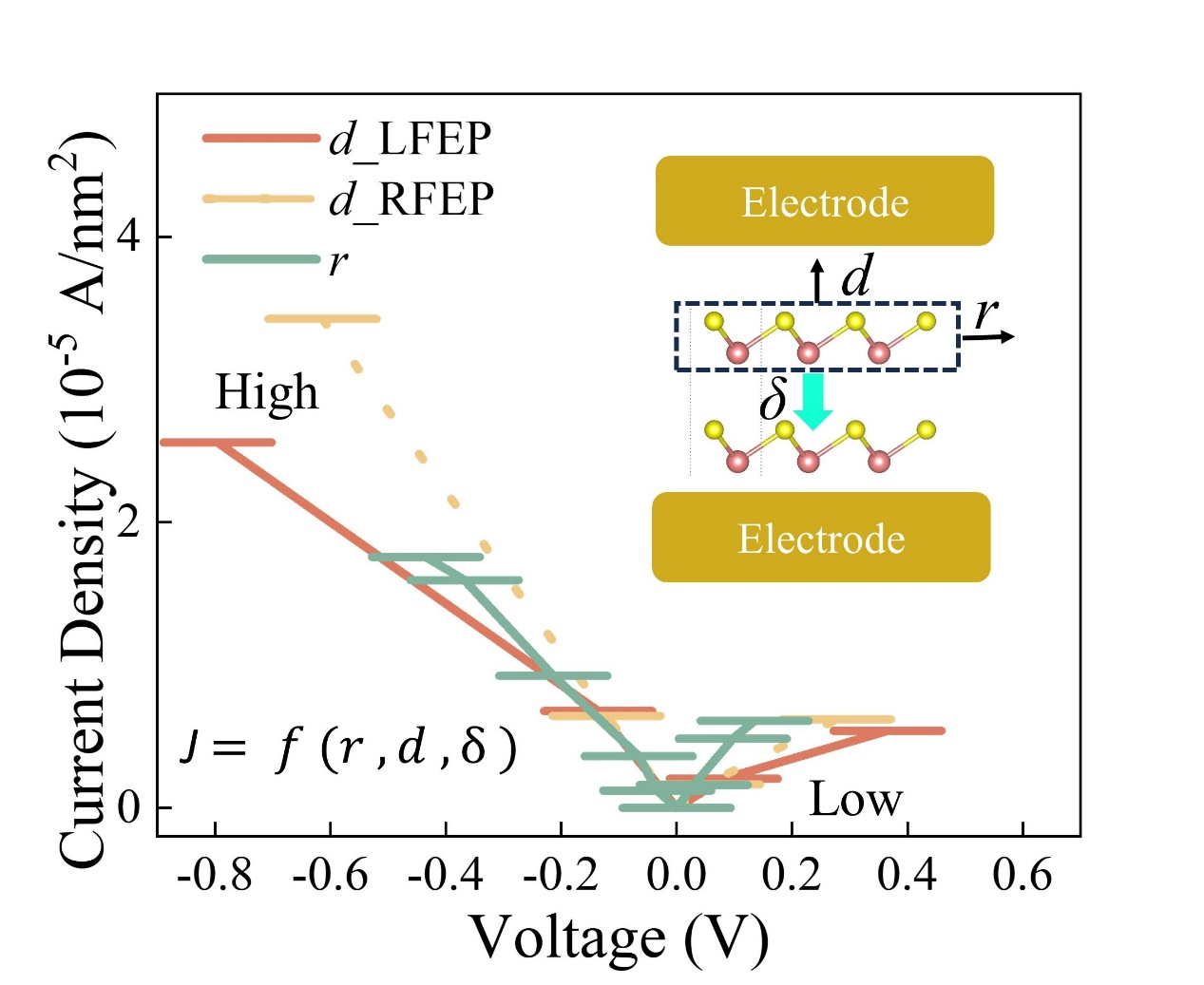
The two-dimensional van der Waals (2D vdW) Janus materials have different atomic species on both sides to ensure their structural asymmetry and inherent out-of-plane polarizations. A novel 2D vdW Janus material, GeS, was found to develop ferroelectric tunnel junctions (FTJs) with low energy consumption and high response speed. Based on our first-principles calculations, it is found that the Janus GeS bilayers own three stacking modes, and their lateral sliding and vertical displacement can both modulate the electron transport in GeS bilayer-based tunnel junctions. In addition, the FTJ based on GeGe-contacting GeS bilayer exhibits the highest on/off ratio. Our study expands the concept of sliding ferroelectricity to a new class of 2D vdW Janus materials and reveals the possible resistance switching mechanism of these materials in real devices. Furthermore, it provides theoretical guidance for the design of low-energy-consumption and fast-switching nanodevices based on 2D vdW Janus materials.
SUN Kang, BIE Jie , LV Yang-yang, CHEN Shuang, FA Wei . Electron Transport in Ferroelectric Tunnel Junctions Based on Two-Dimensional Janus GeS Bilayers[J]. Progress in Physics, 2024 , 44(4) : 183 -207 . DOI: 10.13725/j.cnki.pip.2024.04.003
/
| 〈 |
|
〉 |